Sunday, July 6, 2025

Searching for my patriotism amidst the rubble

By Mary Kay Roth

Fifty years ago, I wore my love beads and burned the flag, protesting against the Vietnam war – protesting for civil rights and women’s rights – protesting all things wrong with our country.

I was accused of not being a patriot.

After all, I’ve never really liked the Star-Spangled Banner and “the rockets' red glare, the bombs bursting in air.”

Through the years I’ve continued to balance a love-hate relationship with the United States of America, further complicated over the past decades with George Floyd, Jan. 6 and a wash of new books and tough truths that question the blind “greatness” in our country.

Rah, rah, rah.  Yeah right.

So, on this red-white-and-blue holiday weekend I’ve been thinking a lot about patriotism, what it means for me.  And, if the outbreak of similar columns is any measure, I’m not alone in asking: Do I still love this country?  

Mark Twain's perspective on patriotism is acutely appropriate right now: "Patriotism is supporting your country all the time, and your government when it deserves it."  He believed the phrase "My country, right or wrong," was an insult to the nation. 

I certainly don’t love my government when it is led by racists, xenophobes and evil doers who believe the American dream involves erasing the Constitution and coldly cutting off anything good – forgetting the very things that make this country great. 

I don’t love my government when black-masked agents nab refugee and migrant families from their homes and take them away without due process – when 17 million people are now projected to lose health insurance – when the wealthy further line their pockets.

I don’t love a president who not only exposes but champions the underbelly of America – or congressional folk who, just in time for Independence Day, pass perhaps the most horrendous piece of legislation in memory: devastating Medicaid, cutting food assistance for children, diverting public school funding to benefit rich families, boosting an already out-of-control deportation force, defunding Planned Parenthood clinics and so much more.

These days, many of the younger generations don’t believe in patriotism, my own kids questioning why we need to love a specific country.  They challenge me to love and care for an entire world.

I understand the value of embracing everyone around the globe.

But there were moments over July Fourth this year when I paused – in wonder..

When my grandchildren of different colors played side by side.

When the news was filled with neighborhood children’s parades as well as nationwide protests.

When good friends scrambled to furnish an apartment for a new refugee family – while others started a Fund A Need for a young woman suffering addiction and losing Medicaid.

When my granddaughter made a new friend at the zoo – just by sharing toys in the sandbox.

Turns out, perhaps a bit reluctantly, I do love my country.  I love what it can be and should be.  And I won’t allow right-wing jingoists to kidnap my flag, when I still believe it stands for a set of ideas worth defending.

I love my country when I continue to write blogs and social media posts that criticize – without reprisal.  (Admittedly, at least for now.) I love the USA when columnists and journalists openly blast our country ... specifically over the Fourth of July.

I love my country when Trump fades at the polls while I experience an exhilarating sense of comradeship with those who celebrate those polls.

I loved my country while I stood arm in arm with folks at Woods Park, lining O street and chanting “No More Kings,” joining more than 4 million people in massive protests across the country – overshadowing President’s Trump’s dismal parade.

I loved my country when, as I protested, several trucks pulled up in front of us – and they weren’t there to take us away.  They were trucks from a local business employing migrant workers who pulled out coolers of water to thank us all. 

Like Mark Twain, I adhere to the distinction between loyalty to one's nation and loyalty to its government. Authentic patriotism involves a discerning approach, supporting our government when it acts justly. Never when it does not.

I liked these recent words from USA Today writer Rex Huppke: 

“In this rather pivotal moment in American history, how do we celebrate America – the right-now version of America – when democracy looks as fragile as a cracked sheet of thin ice over a warming pond?

“I imagine everyone will have a different answer, and I’m not here to claim I know best. But as a critic of Trump and all he has done to mangle this country and its sense of decency, I can share my form of Fourth of July patriotism.

“We can love this country and loathe the people in charge. We can be simultaneously proud of this country and embarrassed of the things being done in its name.  My America is welcoming, and just, and decent. And no two-bit con-artist president is going to take away my belief that these un-American actions can and will be stopped.”

Yes, perhaps right now it feels like our house is burning alongside our fireworks, but it’s still our house. Personally, this is the country where I was born, grew up, a country I want to help salvage for my children and grandchildren.

How do we accomplish that?

The amazing Anne Lamott had some ideas in her latest column: “Anyone paying close attention to the news might well ask themselves what on earth there is to celebrate this Fourth of July. But we must celebrate, or they win, in the paranoid sense of “they.” They want the day, but we can’t let them have it. Independence Day is America’s day. Sure, we bleeding-heart nervous cases are teetering on the edge of despair, but that is exactly why I am calling for us to move into a new phase of resistance: hope and joy. In ghastly times, these are subversive.

This Fourth of July, she proclaimed, “My friends and I will celebrate the land that embraces political marches and rallies, the ones so far and those still to come. This is “We the people,” and that is the ultimate and most profound aspect of America. We are going to keep showing up and talking about what needs to be done and what is possible right now. We give some money, if we can, to food banks, to a congressional candidate in a swing district, an immigrant rights organization, the ACLU and Project Hope. We steady ourselves for whatever the future might hold — left foot, right foot, left foot, breathe. Yes, things are god-awful in so many ways, maybe especially the dismantling of USAID, but we can’t go limp. This is what they want.” 

Lamott remembers George Carlin’s profession, “’There are nights when the wolves are silent and only the moon howls.’ …  That night is now. We are the moon shining in the dark. We have begun to howl as one, as this new thing is getting itself born.” 

So, as this holiday weekend comes to a close, I am indeed celebrating July Fourth this year - and I am howling.

Howling out America the Beautiful, not the Star-Spangled Banner.

Howling a nuanced patriotism guided by reason and principle, rather than blind adherence.

Howling with subversive, unbridled, patriotic joy.

Because when we stop believing, we slowly lose our hope in humanity.

I hope you find your patriotism this year.  I’ve found mine.


Monday, June 30, 2025

June Respite From The Mayhem

In times like these, when it feels like we're walking a tightrope between uncertainty, upheaval, and outright insanity, it can be challenging to stay grounded in who we are, and more importantly, who we want to be. For this week's edition, 5 Women Mayhem is posting more of a photo essay, if you will, depicting what has helped us stay grounded in the swirling midst of Mayhem over the past month. 

Whether it's showing up for and with community, connecting with Nature, playing in the sprinkler with a silly dog, or listening to a good old country song, do what you need to do to be the "You" that you want to be, and don't let the Mayhem overshadow the joy and beauty in life. Deep breaths, Friends. We've got this.

Beautiful World" by Dierks Bentley

All the noise and the voices are screamin'
What they have to say
And the headlines and sound bytes are givin' me
Demons to hate

And the man on TV
He tells me it's ugly
But if you ask me
It's a beautiful world

There's tears and there's fears and there's losses and crosses to bear
And sometimes the best we can do is just to whisper a prayer
And press on because
There's so much to live for and so much to love
In this beautiful world
Say what you will but I still believe
It's a beautiful world

And I know 
I'm not dreamin'
I just choose to believe it
So I hate that I sometimes miss what's right in front of my eyes,
And I know at the end of my road I'll be wantin' more time
Just another sunset
One more kiss from my baby
A smile from a friend
In this beautiful world.

(You can listen to the song on YouTube by clicking on the title link above.)


Follow us on Facebook @5WomenMayhem


Sunday, June 22, 2025

Looking for safety


By JoAnne Young


I have to tell you this, though I rather wish it wasn’t true. The man who is at the helm of our country, and the man in charge of the country of Israel, shifted my plans this weekend to write about an airier topic. But because I feel less safe today than I did on Friday, I feel compelled to talk about it. 


I have found that the more people I know and care about, the more important safety becomes ... theirs and my own. The more I learn about all the things that can go wrong in the world, the less stable I feel. Every morning I tell myself, I got through yesterday and last night. That’s all I’m sure of right now. And today I’m less sure of that, because the powers that be are less and less concerned about the people they “govern.” 


It's looking more and more like my country is going to join with Israel in the killing of a lot of people in the Middle Eastern country of Iran. The president, elected by 77.3 million American voters, 49.8% of the popular vote, is warning this weekend of tragedy for Iran, that many targets are left, targets that can be taken out in a “matter of minutes.” That will happen, he said, if the leader of Iran doesn’t opt for peace, doesn’t say, “OK, I give.” 


We can be pretty sure that won’t be the response. 


So what is there to do about this weekend’s news? One piece of advice from writer Anne Lamott was: “Today we just keep the patient comfortable.” I like that advice. Here is what has made me comfortable. 


I have no control over what these men who are the leaders of fighting countries have done or will do. I do have control over my own safety, and the safety of those people I directly encounter. For my part, this weekend I bought a new car with good safety features. It won't  affect world peace. It may sound frivolous. My hope is that it will calm me when I am on the road. My hope is that if I happen to wander out of my lane, or if some soul stops suddenly in front of me or runs a red light, I have some protection and so do they. 


When I was a teen, I didn’t think a lot about safety. My first car was a very used Renault Dauphine, built in the 60s. There wasn’t a safe bone in its blessed turquoise body. I soon learned that at any given left turn, the passenger side door could fly open. There were no seatbelts. My friends and I laughed about this possibility, even harder when it actually happened. 


I took chances, running out of gas far from my home, taking cross-country trips in shoddy cars, hitchhiking. I drove down dark wooded roads. I got stuck – alone – on muddy roads after midnight. 


Life has taught me well. I have learned first-hand and in other’s stories about the quick turns it can take. I recently read a book of essays and stories by Marina Keegan, who in 2012 wrote an essay for her Yale University commencement titled The Opposite of Loneliness. In it she wrote: “We’re so young. We’re twenty-two years old. We have so much time.” 

She was dead just days after her graduation. Going home to Cape Cod, her boyfriend, who was driving, fell asleep at the wheel, crossing two lanes and rolling the car. She died at the scene. 


Recently someone asked me what my plan was for my life going forward. My reply: One day at a time. I am fully aware of active shooters, icy sidewalks, hazardous weather, distracted drivers, and any number of illnesses that can sneak up on a person. 


I don’t plan to live in fear. I do plan to take note of exits wherever I am and whether exit doors push or pull. I will turn on lights so I can see where I’m walking. I’ll be aware that life can be unpredictable, wild, and uncomfortable. Mayhem does indeed fire up whether I expect it or not. 


I have said this before, and must keep reminding myself, that there is safety in our tiny circles of like-minded people where sanity, at least for short periods of time, abounds. Also, that we are in this together, whether we think alike or not. 


We’re all just trying to live, rest, repeat. May good forces be with us all. 


5 Women Mayhem. Like us on Facebook. We'd love it if you'd share our blogs with your friends. 


Saturday, June 14, 2025

A week to walk...for so many reasons

by Mary Reiman

Let’s begin by walking through this week in history. 

June 8th, 1789, in an address to the House of Representatives, James Madison proposed amending the Constitution to include the Bill of Rights. The First Amendment includes the right of the people peaceably to assemble, and to petition the government for a redress of grievances. Do our elected officials remember the Bill of Rights? 


June 9th, 1954, during the Senate Army-McCarthy hearings, Army special counsel Joseph N. Welch berated Senator Joseph McCarthy, asking: “Have you no sense of decency, sir? At long last, have you left no sense of decency?”    It is now 2025, how does our Congress defines ‘decency’ today?

June 10th, 1963, President John F. Kennedy signed into law the Equal Pay Act of 1963, aimed at eliminating wage disparities based on gender. 62 years ago. Today the Center for American Progress reports that full-time working women, regardless of hours or weeks worked, will not obtain parity until 2052. 

June 11th, 1963, the University of Alabama was desegregated as Vivian Malone and James Hood became the first two Black students allowed to enroll in classes.

Governor George Wallace initially blocked the doorway to the auditorium where course registration was taking place, delivering a speech before deferring to National Guard orders to move.  The National Guard has been deployed throughout the country this week.

June 12th, 1942, Anne Frank received a diary for her 13th birthday. Her family went into hiding from the Nazis a month later. How many children are in hiding today?

June 13th, 1966, the Supreme Court ruled in Miranda v. Arizona. Criminal suspects had to be informed of their constitutional rights to remain silent and consult with an attorney. How is this ruling interpreted today?

June 14th, 1775, the Continental Army, forerunner of the United States Army, was created by the Second Continental Congress. My dad was in the Army from 1942-1945. 

What will the American History textbooks say about the days of June in 2025? 

If you watched the Tony Awards on Sunday evening, you heard many actors and directors giving voice to how they feel about the state of our nation. Francis Jue, for his role in Yellow Face, won Best performance by an Actor in a Featured Role in a Play. In his acceptance speech he passionately said to those who feel disenfranchised. “I see you.”

As we walked this weekend, I looked around our community. The streets were lined with homemade signs. All ages holding those signs. Boomers, Gen X, Millenials, Gen Z and Generation Alpha (some in strollers). Walking to remind ourselves, as well as our government officials, that we are guaranteed our rights.


We walked for Pride, for our Rights, for our Democracy. We walked in this city of generous souls who donated $9,501,701 this year to 502 nonprofit organizations on Give to Lincoln Day. It is what we can do…and we did. We can give directly to our community for the many, many, many organizations that support those in need…and we did. We can’t always convince our legislators or our state officials or our federal officials to fund much needed resources (health care/food inequities/public education/libraries and museums, to name a few), but we can do so locally…and we did. I am proud of our city. And I greatly appreciate all who work tirelessly advocating for their organizations.  


So on this Flag Day, we dissent. Because it is our right. To show we are concerned/worried by comments such as “I didn’t read it” and “I didn’t mean it” from our elected officials. 


So many handwritten signs from today’s peaceful protest demonstrating the fears and frustrations, such as:

“We the people are the final guard rail”

“First they came for the immigrants”

“I’m too old to be this mad”

“Seeking safety is not a crime”

"Free speech. Free country"

"Fight ignorance not immigrants"

"We no longer have a difference of opinion. We have a difference of morality"


Standing together, sharing stories, helped us each realize we are not alone.


We are making, in the words of John Lewis, ‘good trouble.’


And we will keep walking...


Saturday, June 7, 2025

Sine Die...but not quite


 By Marilyn Moore

The Nebraska legislature adjourned Sine Die on June 2.  Another session, done.  Another session, with a huge budget deficit to manage.  Another session, with daily references to reducing property taxes.  Another session, with bills that hurt real people – bills that restrict access to food and health care.  Another session, where the will of the people, the legislature’s second house (that would be us, the Nebraska voters), is ignored with bills that counter our passage of legislation regarding minimum wage, paid sick leave, and medical marijuana.  Another session, with deliberate attempts to infuse religious instruction into the school day and provide public funds for private schools.  Another session, where one very small group of Nebraskans was vilified, humiliated, and lifted up for public abuse.  Our trans neighbors, especially, our trans children, were the targets.  

An inordinate amount of time was spent by the legislature on LB89, which defined “male” and “female” according to biological reproductive characteristics at the time of a person’s birth, and restricted athletic competition and use of locker rooms and bathrooms accordingly, according to a person’s sex assigned at birth.  A last-minute profile in courage moment by Senator Marv Riepe stripped the provisions about locker rooms and bathrooms from the bill; his statement that he didn’t run for office to be a part of the “Nebraska potty patrol” is the most memorable line of the session.  Without those provisions, the bill passed, and the governor signed it into law with a big press conference, proudly announcing his support for women.  

I’ve written about this before, and I told myself I would not address this again.  There’s only so much that can be said, and I’ve said a lot.  Until…in the governor’s press conference as he signed LB89 into law, he commented that the provisions about locker rooms and restrooms would be addressed in legislation next year.  No surprise there, of course it will be back, because it’s one of the hot culture items that a segment of our population expects.  But then he said that until laws are passed regarding who can and cannot use school bathrooms, he has confidence that most young boys and men in Nebraska know right from wrong, “and they’ll take care of whoever tries to go into the locker room.”  

That sounds like vigilante language.  The governor said later that he didn’t mean that at all, that he would never promote violence.  He simply meant that he expected boys to have peer-to-peer conversations.  I hope that students will always encourage each other to follow the school rules; that’s part of being a good citizen.  Some peer-to-peer messages that would be helpful would include, “No means no.”  “Don’t interrupt her.”  “Yes, girls can be scientists, and boys can be artists.” But I’m very concerned about vigilante language, language that encourages people to take rule-enforcement, or law enforcement, into their own hands.  Because it’s easy to move from “it’s against the rules” to “it’s wrong to be gay, or trans.”  At its most extreme, this led to a century of lynching of Black Americans.  And it leads today to violence again LGBTQ persons; Matthew Shepard’s story is a part of this generation’s story.  

In addition to the vigilante language, I’m also concerned with the repeated messages that trans kids are getting from some elected officials – that they’re not normal, they’re not okay, they’re not who they know they are, they’re not welcome.  And when the next iteration of LB89 is introduced next year, they’ll hear those messages again and again and again. Those messages inflict very real damage.  The suicide rate for trans teens is way higher than that of cis teens.  I know families who are moving out of Nebraska to states with a more friendly stance toward trans children and their parents.  And when a teen who is different from the norm in some way, e.g., size, skin color, religious practice, sees a trans teen threatened because of who they are, that teen will likely fear that they, too, could be threatened because of who they are, different, in some way.  Vigilante language invites this.

Not every social issue needs to be addressed by state law.  Who plays on sports teams doesn’t need to be codified by statute.  There are state and national organizations that govern everything about interscholastic and intercollegiate competitions; they will figure this out.  It’s noteworthy that in the past seven years, exactly eight trans students in Nebraska have applied to the Nebraska School Activities Association to play on a high school sports team matching their gender identity.  Eight, in seven years, out of more than 100,000 high school students in that time period.  Not an overwhelming problem.  

Who uses what restroom or locker room doesn’t need to be decided by the legislature.  If a student is assaulted in a bathroom, the assault is a school rule violation and likely a statutory violation; there are procedures to handle that.  If a student is bullying another student, or harassing a student, or threatening a student, there are school rules against that, and a school procedure to deal with it.  Principals do not need state statutes on this issue.  

Most of all, our trans children and young adults do not need to be the subject of ridicule, fear, and exclusion.  They did not choose to be trans, any more than I chose to be cis.  They are who they are, real human beings, loved by God, struggling to live in a society that at best does not understand and at worst is hateful.  In this Pride month, I’m looking for ways especially to support the “T” people in the LGBTQ population.  I invite you to join me.


Sunday, June 1, 2025

A completely unexpected blog: A moment of compassion in a harsh world


By Mary Kay Roth

After a stunning sunrise at the lake this morning, I was walking back to the parking lot with my two walking buddies – Bethany and Anne – when my dog, Pip, started fiercely pulling on the leash and looking back toward the dam. We saw that Pip was gazing into the distance, watching a woman cautiously inch her way down the steep, paved path along the side of the dam.

She was dressed in a long, beautiful saree, but it had been raining and the path was slippery. Suddenly she stumbled and sort of somersaulted down at least half of the pathway.  

She landed hard. And she was still. 

We all went running.

By the time we reached the path, the woman was grasping at bloody and already swelling knees. We gently approached and started asking questions, but quickly discovered she couldn’t speak English.

She was terrified and said very little, but quietly cried and simply rocked back and forth in pain.

Bethany went running for a first-aid kit from her car while Anne sat down beside the woman and embraced her.

The woman started to pray and we prayed with her. We kept telling her we were there to help and tried showing her how to breathe.  She was sobbing in obvious distress but watched us and tried to calm.

We shared our names and she spoke for the first time.  Her name was Sujata.  

She told us the language she spoke and upon googling, we puzzled out that she was from India.

A dog walker along the path noticed us and asked what happened, then explained she was a nurse practitioner.  She looked over the woman, gingerly, checking on the painful areas.  She suggested she call an ambulance – and did.  She warmly wished us good luck and headed on.

The four of us all started to hold hands and we tried to tell the woman help was coming. We formed our hands in prayer together.

A lovely quiet surrounded us all.  And despite the trauma of the moment, it was somehow impossible not to pause in wonder.  We had no language to share, but here were four women in a circle of care and support.  

“Even though we didn’t speak the same language,” Anne said, “we all understood compassion, love and caring.”

Ever so subtly we started hearing sirens in the distance and knew help was coming.  We squeezed Sujata’s hands, told her to hold on.

And just as the fire truck and ambulance pulled up. the woman’s grown son came running.

His name was Shrikanth and he has lived here a decade. His mother only arrived this week.  

Apparently they had gone for a walk but his mom wanted to take a short jaunt on her own.   Just a short one.   Then she had vanished and her son had been searching for her.

The emergency folks immediately went to work and did a quick examination.  They managed to lift Sujata onto a stretcher and move her toward the ambulance.

Gratefully her son could translate.

And though the woman was incredibly frightened, she continued to hold our hands until the very last moment – speaking perhaps the only English words she knew.

“Thank you.  Thank you.  Thank you.  Thank you.” 

“Oh, thank you, thank you.” 

Bethany gave her son directions to the hospital.  We all hugged the woman one last time and by then we were all crying.

The ambulance pulled away.  My friends and I were alone again.

We talked about concern over all the red tape and barriers they will face.  I fear she has a broken leg. Bethany got the son’s phone number so we will be checking.

But we also held one another this morning in deep gratitude.

For a dog with super powers.

For a nurse practitioner who stopped to help.

For great medical responders in our community.

For three women being at the right place at the right time.

You know, I was going to write a blog today, ranting again about Trump and all his continuing and despicable actions.

But I’m left with a dramatically different feeling this special morning.

Our hateful president can hand down all the executive orders he wants.  He can impose initiatives that result in cruelty and harm.

But he can’t stop three women from stopping to help another woman in trouble.  

He can’t stop us from holding hands and hugging.  

If we’re willing to pay attention. If we’re willing to respond when the moment calls to us.

Nothing can stop us from caring for one another. Nothing can stop basic human compassion.

We’re praying for you, Sujata.


Tuesday, May 27, 2025

On Memorial Day we remember and tell the stories of those men and women who served our country, and especially those whose sacrifice was the most a person can give, their lives. Most of us personally know one or two or more of these beloved soldiers, Marines, sailors, etc., many of whom know deeply the meaning of mayhem. 

***


Collateral Damage

By JoAnne Young 

Sometimes the scars of the battlefield aren’t only vested on those on the land and seas of the fight. Sometimes, as in this case, the collateral damage has a far reach. This is the story of Betty Long, a survivor of that damage. I didn’t know her or her husband who died in battle. I only know them through a grave marker at Wyuka Cemetery of their baby daughter, and her father’s and mother’s story I felt compelled to learn. 

Patricia Ann only lived three months. Her daddy, Sgt. Harold Wesley Long, followed her just a year later, mortally wounded on a battlefield on Leyte Island in the Philippines. He was awarded a Purple Heart and a Silver Star a year after his death for bravery on an earlier European battlefield for nearly single handedly continuing to fire on the enemy, to allow for evacuation of his dead and wounded comrades. 

Patricia Ann, who got no time to create lasting memories, was awarded only this: her name engraved in stone for me and others to see walking by some 80 years later. Recognition as her parents’ darling, born September 1943. Died December, same year. The marker also commemorates her father’s death in November 1944. 

Mostly, I think of her young mother, Betty, who got no name mention. But with research I learned that Betty, within one year, lost that darling baby, and then her beloved soulmate, who she had married as a teenager. 

Betty didn’t remarry for nearly 20 years after that devastating year, and had no children after Patricia Ann. Before she died in 2016, at age 92, she had also lost her parents, her second husband, and all five of her siblings. She chose to be buried in Carthage, Missouri, resting forever by her first love, her soldier. As I am imagining her life, I think maybe, when she heard of his death so many years before, she had made a secret vow to Wes to be by his side again someday. He only had to wait 72 years.

***

They Never Really Talked About It….

by Marilyn Moore

My dad, John A. Ruf, M/Sgt., enlisted in the Army at the beginning of WWII.  He was assigned to Turner Field in Albany, Georgia, where he was a flight mechanic.  Turner Field was the site of pilot training, and Dad was one of the men who kept the planes flying.  He didn’t talk about his time in the service.  But he kept a few mementos, including a pocket-sized notebook where he recorded the work that he did.  His notes indicate precision and attention to detail.  To my knowledge, once he completed this tour of duty he never flew again; I think he was a man who was glad to plant his feet on the ground.  While he didn’t talk about being in the Army, he did talk about the friends he made there.  He and his friend Roger Brown, who lived in Barnesville, Georgia, talked by phone several times a year; given the cost of long-distance phone calls, I know it was an important friendship, one they both valued. 

Dad’s good friend, Ervin, was one of the soldiers who stormed the beaches at Normandy on D-Day.  When I asked him about that, just a few years before he died well into his eighties, he said he never really talked about it.  He remembered the other soldiers on that boat that landed in France, describing them as “good boys,” from Nebraska and South Dakota, just good boys.  And that some of them didn’t come home. 

Several years later I was leading a study at church of Mary Pipher’s book, Another Country.  It’s a book about aging, and several members of the group were of my parents’ generation.  The conversation one evening diverged to the WWII experiences of those in the group.  Of the four men, all had served.  One was in the North Africa/Italy theater.  One was a Navy officer, based in San Diego.  One was aboard a weather ship, in the north Pacific.  One was a conscientious objector, assigned to a medic unit in Great Britain.  Hesitantly, they acknowledged that they had never really talked much about these years, but that night, they did.  As I watched their faces, I saw the knowing glances that passed among them, acknowledging shared experiences that did not need words.  I remember feeling honored to be in the room with them during this tender, touching time. 

All these men, my dad, his friends, my church friends, served when asked.  They went where they were sent, they did the jobs that were assigned, they had experiences that were boring and terrifying and meaningful.  They did their part to make the world safe from fascism.  And when they were discharged, they came back home to become farmers, professors, ministers, and businessmen.  They married.  Four of them had children; two did not, but became “the second dad” to kids in the family and the neighborhood, who were grateful.  They were part of what has been described as The Greatest Generation. I do not know if they gave much thought to their years of service.  I don’t know if they had nightmares from what they had seen.  I do know they showed up at ceremonies on Memorial Day.  While their experiences varied greatly, there is one thing they shared: they never really talked about it.  I wish I had asked….

***

Memories of a brave young woman (my mom) enlisting in World War II 

By Mary Kay Roth

We’ll never know for certain why mom joined the WAVES, the women’s branch of the U.S. Naval Reserve in World War II. 

Back in the early 1940s she was teaching in a rural one-room schoolhouse and dreamed of adventures awaiting, far from her tiny hometown of Otoe, Nebraska. 

But I’ve always wondered if there was more. Later in our lives she would show us photographs of her high school sweetheart, Benjy, who never came home from the war. So, I’ve long suspected that mom’s plans for a future vanished with him.
 
In the end it doesn’t really matter, as I’m in awe of her, joining more than 80,000 brave women who served in the WAVES (Women Accepted for Volunteer Emergency Service). 
A young woman who had never been much further from home than teacher’s college in Peru, Nebraska – was sent to basic training at Hunter College in The Bronx.
   
Years later, when my own children interviewed “Grandma” for class projects and asked about the scariest thing she’d ever done – she talked of walking those daunting streets of New York City and wondering if she should pack up and go home.
 
She stayed, then hopped a cross-country train to a major U.S. Naval station in Seattle, Washington.
 
So many movies from that era picture military trains during the war. And I wonder if mom sat quietly alone in her seat, or joined the chatter of the dining car, or listened to music blaring from train car speakers. I wish I had asked her more.
 
I do know she arrived in Seattle where thousands of sailors were stationed – and only a couple hundred WAVES.
 
She was assigned telephone switchboard duty at first, though other WAVES worked in wide-ranging tasks: encoding and decoding messages, sorting mail, serving in naval hospitals and dispensaries.
 
During those initial months, mom’s work schedule was erratic, covering nights, then days, then half and half.  Apparently, at some point those crazy sleep patterns created something of a breakdown for her.  Letters she kept from the war indicate her mail was briefly re-routed back to Otoe, then to a different naval station in Sun Valley, Idaho. 
Mom talked about Sun Valley as one of her favorite experiences in life, a paradise of beautiful landscapes and a new assignment with a naval psychiatrist who was trying to ease the emotional scars of fragile sailors. She loved the work.
 
Of course, somewhere in that first year of navy service she also met my dad – in a legendary family meet-cute: Mom ducking into a barracks to adjust the garters on her nylons and dad – an electrician sailor poised atop a ladder adjusting some wires – looking down upon what he called the most beautiful pair of legs he had ever seen. 

Eventually they married, dad was assigned to the South Pacific while mom continued in Sun Valley. When the war ended and everyone came home, men were favored for any and all jobs, and women were tucked back into their boxes of home and family.  
Through the years mom responsibly ran our household and raised four children, but I always believed she was never quite at ease in that traditional role.
 
So, every Memorial Day, I picture her dressed in those crisp Navy outfits, blue wool in the winter, whites in the summer – uniforms I still treasure, folded away neatly in my cedar chest. 

***

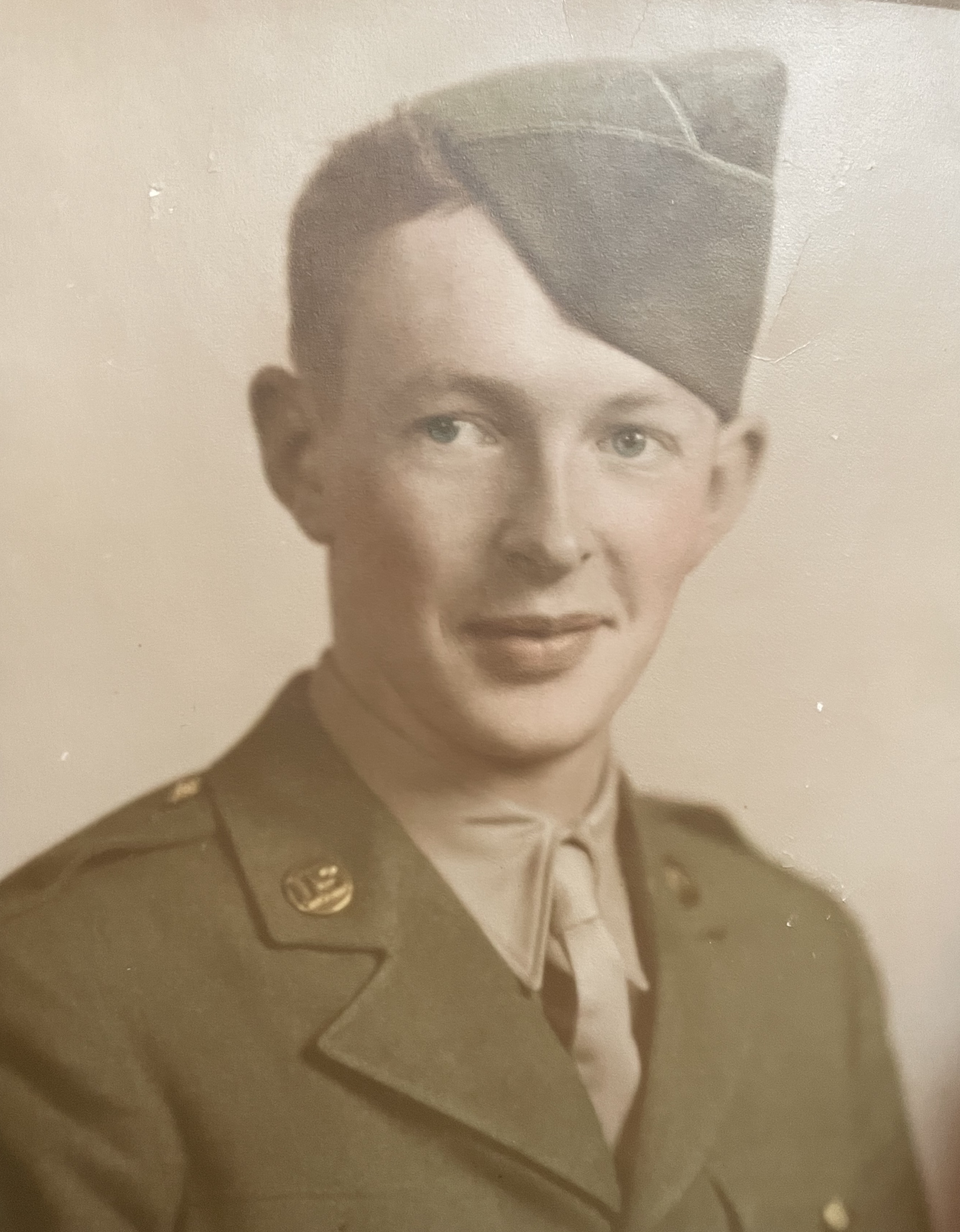
Dad
By Mary Reiman

He was 21 when he enlisted. Although he never talked with us about his war experiences, he was proud of his service.

He looks so young in this photograph.

Too young...

                                                                        ***


                               Like and Follow 5 Women Mayhem on Facebook