Sunday, October 22, 2023

A Special Bond


by Mary Reiman

When my sister and I were together last week, I told her I wanted to write about our last chapter, at least what felt to me like the last chapter of this part of our journey. Back in Iowa together, honoring our parents, visiting the farm, seeing the quiet beauty of fall at Lake Okoboji, with the vacationers gone and the rides at Arnold Park silent. Closure was upon us.

I wanted photos of what fall brings to this part of the country. As I turned onto the rural road, there was a woman and her child taking lunch to her husband in the field because he didn’t have time to stop while combining. The memories bubbled up and I found myself stopping for pictures of the flat golden cornfields, the combines whirring, more wind turbines that have been added since the last time I had driven on that road, and the autumn shades of vibrant trees and bushes.

Somehow, I knew I would weave those into this story about the land.

We both arrived in Milford about the same time, she from two hours north and me from four hours south. I always let her know when I am in South City so she can begin her trip and meet me at our hotel (we think it's ours since we've been going there so often in the past 10 years and they know us well). As always, we then ate lunch in our favorite cafe and headed to the farm. I made her stop along the way so I could take pictures of the vibrant trees,


the neighbor's field of hay bales,
and the combine methodically heading down the corn rows. So many of our childhood memories surrounding us on that sunny October afternoon. 


Then we drove into our driveway, stepped out of the car and stared at the land. That’s when I took this picture. And I realized none of this journey would have been the same without her. My sister. 


We have each spent this past year maneuvering through the process of understanding how to traverse the rest of our life’s journey without mom’s presence here on earth. We were well aware, especially my sister, of how to pay the farm bills, how to understand what CSR (Corn Suitability Rating) means, and who to talk with at the county courthouse to have our farm questions answered. 

More than ever, I realize my sister is the reason it’s not as hard to go back to Iowa, to visit the cemetery, to finalize the paperwork. She’s always been the organizer. She is meticulous. She was the executive secretary of a school. She took care of everyone and everything. Not sure where she got all those genes, but she’s made good use of her organizational skills throughout the years, especially when mom could no longer take care of her own taxes and paperwork. And when I am with her, I see and hear mom. Sometimes that is almost spooky, most of the time it is soothing.

I wasn’t going to write about her, I was going to write about the land. But last week I realized that being beside her on that flat, flat land is what makes my heart happiest. Sharing our love for the farm, listening to her talk about her great joy and appreciation for the soil that produces crops that ultimately help feed the world.  

Of course, the farm looks different. The house is no longer there. It has moved down the road to provide shelter and security and a home filled with love for another family. The groves of trees are gone. The front yard where we learned to ride our bikes, before mom let us out on the gravel road, is now an access point for the farm equipment. The barn, the corn crib, the cattle yards gone, now all cropland. 

But the driveway is still there, and when we drove in on Tuesday afternoon, we were instantly consumed with all the memories of growing up in that peaceful, safe, loving environment.

This is our world. These are our roots. We are grounded in the earth, on that beautiful quiet land.

It is so very clear to me that the land would not have the same value for me now if it were not for her. We share the love, admiration and history of the farm, and of our parents. No one else will pour over our childhood photos and be filled with such deep joy of those memories, or laugh as hard about our various hairstyles or about the fact our dog (Tootie) always sat on her lap instead of mine for photos. OK, maybe I'm still a little jealous about that! 

And she knows me. It is that simple. Since she was married, we have never lived in the same state. That hasn’t mattered. She’s always been my protector from afar.  I have always sensed it. She’s the one. The one I want to call when the news is good...or bad. She provides me with a sense of calm when I am with her, and it lingers with me long after we head off in opposite directions, back to our daily lives.

Thank you, Cindy, for your unconditional love. We do indeed share a special bond.  As you said in my birthday card, “I hope we never have to go more than 5 days without talking to each other.” 💕




Saturday, October 14, 2023

This I believe


By JoAnne Young


I believe in girlhood. 


The ring of that statement sounds strange in my head. For years I’ve been on a self-determined campaign to persuade people to stop using “girl” when they are actually talking about women. “I’ve started seeing this girl,” says the man dating a woman in her 30s. Or, “I have this girl that does my taxes,” about the well-established accountant. And, “that girl on the volleyball team,” who is 21. It’s demeaning, referring to a grown woman as if she’s a child, immature, lacking authority. Unconsciously or consciously, it implies the “girl” is inferior to men who are her peers. 


That being said, I’ve recently begun thinking about my own girlhood, the memories I abandoned as I focused on womanhood and all the complications that came with it. 


I flashed on pulling a catfish from an Arkansas lake with my dad. 


I smiled, remembering collecting box turtles from the woods behind my house, thinking I could contain them in an open box lined with grass and lettuce, only to have them disappear back into the woods by morning. 


I thought of riding my beloved blue bike up and down a deep, wide ditch, my green cowgirl hat hanging loose and cool at my neck. 


I marveled at my determination to carve an ice rink into my back yard, below freezing temperatures and me shoveling for hours in the deep northern Michigan snow. 


I summoned my high school days, the fun of piling into a convertible, a dozen of us girls riding around the school parking lot, nowhere to be but in the moment.   


Then there’s the one I’d rather forget. My first kiss, at age 11, from a man in his 50s who lived three houses down. He had lured me into his backyard shed under the pretense of tuning up my bike, once there pulling me to him, putting his mouth on mine and telling me to open wider. Dumbstruck as I was, I didn’t even notice what other touching was going on. But I knew, even then, to pull away and get out the door. I booked it home, only to encounter another breach of faith when my parents told me to return to the shed for my bike, while they waited and watched from three lawns away. 


The effect of that stiff, repugnant first kiss, that kiss that would covertly afflict so many kisses to come, was delivered in the undergrowth of girlhood, but manifested in the clearing of maturity. For all of these grownup years, when friends would float through stories of their first kisses, I could only listen and nod, never to tell my own. 


Now, so many decades later here I am, asking to reclaim my girlhood, pronouncing my belief that there was a freedom in spending hours on something that would produce nothing. A freedom in pretending to be someone I would likely never become. Freedom in summer play in which I would Peter Pan promise myself to never grow up. 


And most importantly, I believe in the loosening of the bonds of silence given to those men who would sully our girlhoods and have us forget. 


This I believe, in remembering and reviving the girl and the unspoiled days of the spring of our lives. 


Sunday, October 8, 2023

What's In A Word


 By Marilyn Moore

In a word, power.  That is what’s in a word.  The power to convey meaning, either orally or in writing.  Organizing thought, conveying meaning, to others who understand that meaning…that’s power.  And wherever there is power, there is someone, or several someones, making a decision…about who has it, who can access it, who benefits, and who is left out.

A book from my summer reading remains lodged in my mind.  The Dictionary of Lost Words by Pip Williams is a story embedded in the history of the Oxford English Dictionary, the OED.  I’ve seen copies of the OED in libraries, in offices, and in at least one living room.  It is a gigantic dictionary; in its own words, it is “an unsurpassed guide for researchers in any discipline to the meaning, history, and usage of over 500,000 words and phrases across the English-speaking world.”  

The first edition, which took more 70 years to compile, and was finally completely published in the 1920’s, had 414,825 words.  It’s still a work in progress, of course, because our language is a work in progress.  According to the OED website, recent additions include, among others, speech-to-text, anti-terrorism, gummy, and final frontier.  Among the list of updates words are bedlam, lardon, six-pack, and bitter.  A glimpse into our world….

The question that lingers in my mind is the one that is at the heart of Pip Williams’ book: who decides what words will, or will not, be in the OED, or any other dictionary?  The original OED is described as a massive crowd-sourced document; scholars and readers and researchers and members of the public from English-speaking countries across the world submitted words, and citations using those words, to the editor and his assistants, who would verify the words, and their citations, and resolve differing definitions, and decide if the word would be included.  

Ah, the power of deciding…which words to include, and which words to exclude.  To be included, a word had to have a citation; in other words, it had to have been used in some written source that could be verified.  Think about that for a moment…this decision rule meant that words that may have been in the common spoken language at that time, but that had not been set down in writing in some verifiable text, would not be included.  And whose words might those be? Words used by persons whose language was not typically set in writing…. women, immigrants, those who had not had the opportunity to learn to read and write.  

All this is not to disparage the OED; it is a massive undertaking, and it continues to be a source of not only the meaning, but the history, of words.  It’s just that, as in so many other efforts, decisions about what to include, and what to exclude, meant that decisions were made not only about words, but about people, groups of people. 

If words that describe your history, your language, your culture, your people, are in the dictionary, you’re in the in group, with the power that comes from inclusion and recognition and affirmation.  If words that describe your history, your language, your culture, your people, are not in the dictionary, you are not in the in group, and you lack the power that comes from inclusion and recognition and affirmation.  

And if this is true of words, it is even more true of stories.  Because stories have power.  When we read a story, we may be learning about someone or some setting or some culture quite different from our own…and that knowledge is powerful.  Or, it may be that when we’re reading a story, we’re reading our own story, perhaps in a depth or from a perspective we had not previously known…and that self-knowledge is powerful. 

The very real power of that knowledge, the power that comes from stories, is what drives many of the challenges to books in school curriculum, school libraries, and public libraries.  We are just completing the acknowledgement of Banned Books Week.  A display at one of Lincoln’s public libraries informs the public (data from the American Library Association) that there were 2571 challenges to books in 2022, compared to 1858 in the prior year, a 38% increase.  (Historical context:  there were 339 challenges in 2012.)

Not surprisingly, given the political climate in which we live, the most commonly challenged books are those that are about persons from the LGBTQ+ community or by authors from that community.  Books about race, or racism, or prejudice, are also challenged.  Sometimes the challengers will say that such books conflict with their religious beliefs.  Sometimes they will say that they don’t want their children to know about gay families, or multiracial families.  Sometimes they will say that books about racism or prejudice will make their children uncomfortable.  And because they don’t want these stories for their children, or for their family, they don’t want them available to anyone else.  

It is deeply disturbing to me when a book is challenged by someone who wants the book to be banned from a library collection – a story that is not told, not honored, not made visible.  It is even more disturbing to me when elected officials propose banning books, because that action, if taken, becomes the official stance of the school district, or the state, or the nation.  And using the power of the state to squelch the story, whether in a work of fiction, a graphic novel, or a history book, is essentially saying to those whose stories have been banned that their story, and they, do not belong – this in a country whose founding documents, with a boost from subsequent acts of Congress and Supreme Court decisions,  purport to affirm the value of every person.  It is even more troubling when this position is taken by those running for office, a position that is calculated to win votes, a position that invites voters to affirm that the stories of some are not to be heard, are not valued, and do not belong.

Banning words, banning stories, banning books, has been attempted and done across centuries and across cultures and nations.  Enslaved children in the US were not allowed to learn to read and write; the enslavers knew the power of the written word.  The Germans burned books in the lead-up to WWII amidst the rise of fascism and the Nazi party.  The United States banned words and language and culture, as native children were forbidden to use their tribal language in the residential boarding schools.  Popular sentiment in the United States tried the same during WWI, as German immigrants and German-speaking US citizens were pressured to not speak German.  (The US Supreme Court ruled that Nebraska schools could not be prevented from teaching German, however; it is a landmark decision that affirms the value of the power of words.)   And today, some words must not be uttered in classrooms in Florida, and an Oklahoma leader has made the preposterous suggestion that the Tulsa race riots could be taught without bringing race into the lesson.  These actions reflect the power of words and stories, and the extreme measures which some will take to squelch that power. 

There are heroes in this struggle.  Librarians are on the front line, and they are strong in their commitment to the freedom to read.  Boards of Education in Kearney and in Papillion-LaVista have taken action in the past few months to retain books that have been challenged in their school libraries.  As the popular Facebook meme notes, the book burners have never been seen by history as the good guys. 

Let’s tell the stories, then, and listen to the stories, and keep the stories in libraries.  Stories of girls who become astronauts and boys who become dancers.  Stories of gay kids and straight kids.  Stories of families of many configurations.  Stories of the wise and the foolish, the engineers and artists, the dreamers and the doers.  Stories of generous hearts and stories of scammers. Stories from cultures from around the world, and stories from our own neighborhoods.  Stories that cause us to cheer, and stories that cause us to weep.  Stories that hurt, and stories that heal.  And then, let’s talk about the stories, and learn from another’s perspective.  

Words have power, stories have power; this is a cause for celebration, a cause to defend.  I will do both. 


Sunday, October 1, 2023

Finding bite-sized, five-letter moments of instant gratification – in a crazy world

⬜️ ⬜️ ⬜️ ⬜️ ⬜️

By Mary Kay Roth

Azure. Daddy. 

Two simple words.

And yet over the past two days, they brought hundreds of thousands of people together, worldwide.

You see, lately I’m obsessed with how many five-letter words exist in the English language.  It varies. The Free Dictionary lists more than 158,000 words with five letters – the official Scrabble Dictionary puts the number around 9,000 – and after sorting down to a more reasonable list of easily identifiable words, you come up with 2,315.

Whatever the number, when you find the right five-letter word out of all those possibilities, you find the magic of Wordle – that aha moment – the self-affirming fist pump – a wave of triumph quietly reverberating across the planet.

Took me three tries for azure, on Friday.  Four for daddy on Saturday (those three bothersome D’s perplexed me). And yet it still made me ridiculously happy when I got them right.  

OK, I know all the bad stuff going on. This weekend the government almost shut down. Apparently, Covid is coming back. Icebergs are melting,  mosquitoes are thriving.  And I’m pretty sure there’s a nail in my tire.

None of that matters.  

Because the moment I conquer Wordle, all’s right with the world.

When you Google the question – “Why is Wordle so popular” – you’ll find hundreds of explanations. It’s a simple yet addictive game with easy access.  It’s free, no pop-up ads, no paywall.  You don’t have to register.  It’s limited to one a day.  And in all honesty, it’s not that tough.

⬜️ ⬜️ ⬜️ ⬜️ ⬜️

But for whatever the reason, an estimated three million players (“whordles”) are now signed up – attempting to guess that golden five-letter word.  

Sometimes you breeze through in minutes.  Sometimes you get miserably stuck.  For me it’s a practically perfect combo of challenge and luck – smarts and serendipity.  

And each day we all come together to solve the same puzzle.  Seeking that delicious, bite-sized moment of instant gratification when all five letters come up – gloriously green. 

For the uninitiated, here’s how it works:  Open up the game and you’ll see five empty blocks across, stacked in six rows down – one row for each guess. You have six chances to puzzle out one five-letter word.  And after guessing each time, the game tells you whether your letters are in the secret word. 

  • Green means the letter is in the word and in the correct spot. 
  • Yellow means the letter is in the word, but in the wrong spot.
  • Gray means the letter is not in the word at all. 

In fact, there’s nothing like the feeling of dread when you type in your first guess and all the letters come up gray. Or when you have identified three or four letters and for some infuriating reason – after frantically scribbling preposterous possibilities on scratch paper – you are completely gutted.

 Good grief, I majored in English and Journalism.

The overall average number to nail the secret word in the United States is 4.019.  Sweden is home to the best Wordle players, who complete the puzzle with a 3.72 average, followed by Switzerland (3.78) and Poland (3.79). The USA ranks an uncomfortable No. 18.

North Dakota is the state in this country with the highest success rates.  New Hampshire has the most Wordle cheaters. 

And according to the PGA, the odds of an average golfer making a hole in one are 12,500 to 1. The odds of solving Wordle on the first guess are around a couple thousand to one.

⬜️ ⬜️ ⬜️ ⬜️ ⬜️

I don’t watch my stats all that much.  But I do know that twice I have guessed the Wordle in two guesses.  (Never in one.)  And I’ve been completely stumped by one completely silly word.  Froze.  Go figure.

Some all-knowing psychologists believe you can tell a lot about a person from the way they attack Wordle.  

Many people watch their statistics meticulously. Lots of folks post their results in social media. Some begin with the same word every day, often drawn to words with two or three vowels and common consonants: audio, adieu, alone, canoe, edits, least, media, sauce, slate, train.

I use a different starter word every day (which supposedly means I like taking risks).  I keep a running list of past Wordle words (which means I am methodical).  

And I refuse to look at any of the Wordle spinoffs (which means I am a traditionalist). However, if I were curious, I could choose among variants that include Absurdle, Wordle’s evil twin where the secret word keeps changing – and Sweardle, a four-letter puzzle limited to swear words (damn, how many obscenities are there?).

The origin of the REAL Wordle is a sweet story. Josh Wardle, a software engineer in Brooklyn, knew his partner Palak Shah loved word games – so he created a guessing game during Covid for just the two of them. The game went online November 2021 with 90 players – and grew to 300,000 in just a couple months. The New York Times Company acquired it in January 2022 and today it is recreated in 50 languages for more than three million players of all demographics and ages.

In truth, when I pick up my granddaughters from school these days, they come running into my arms, give me a hug – then ask whether or not I’ve done Wordle yet.

And yes, I know there are snobs who look down their noses at this inane little game, probably people who do the New York Times crossword puzzle in ink.   

I still like a good crossword puzzle, a robust game of Scrabble. I am even lured by the likes of other New York Times games like Spelling Bee and Connections.

But thank goodness there are enough five-letter words to get us through at least seven years of Wordle, because of course it’s about more than guessing an elusive word. 

Wordle is about celebrating the small stuff, a spark of momentary happiness and grace, a tiny semblance of peaceful control over my small space in this chaotic universe.

Each day, for one sweet moment, all those letters eventually will come up green.

And whether I get the Wordle in three, four, five guesses, or – dang it – six, I know it will all soon be forgotten.  Tomorrow I’ll have a clean slate, another try, a fresh Wordle word.  

And life will be good. 

Whether or not the government shuts down.

⬜️ ⬜️ ⬜️ ⬜️ ⬜️


Sunday, September 17, 2023

A Partnership Like No Other

By Mary Reiman

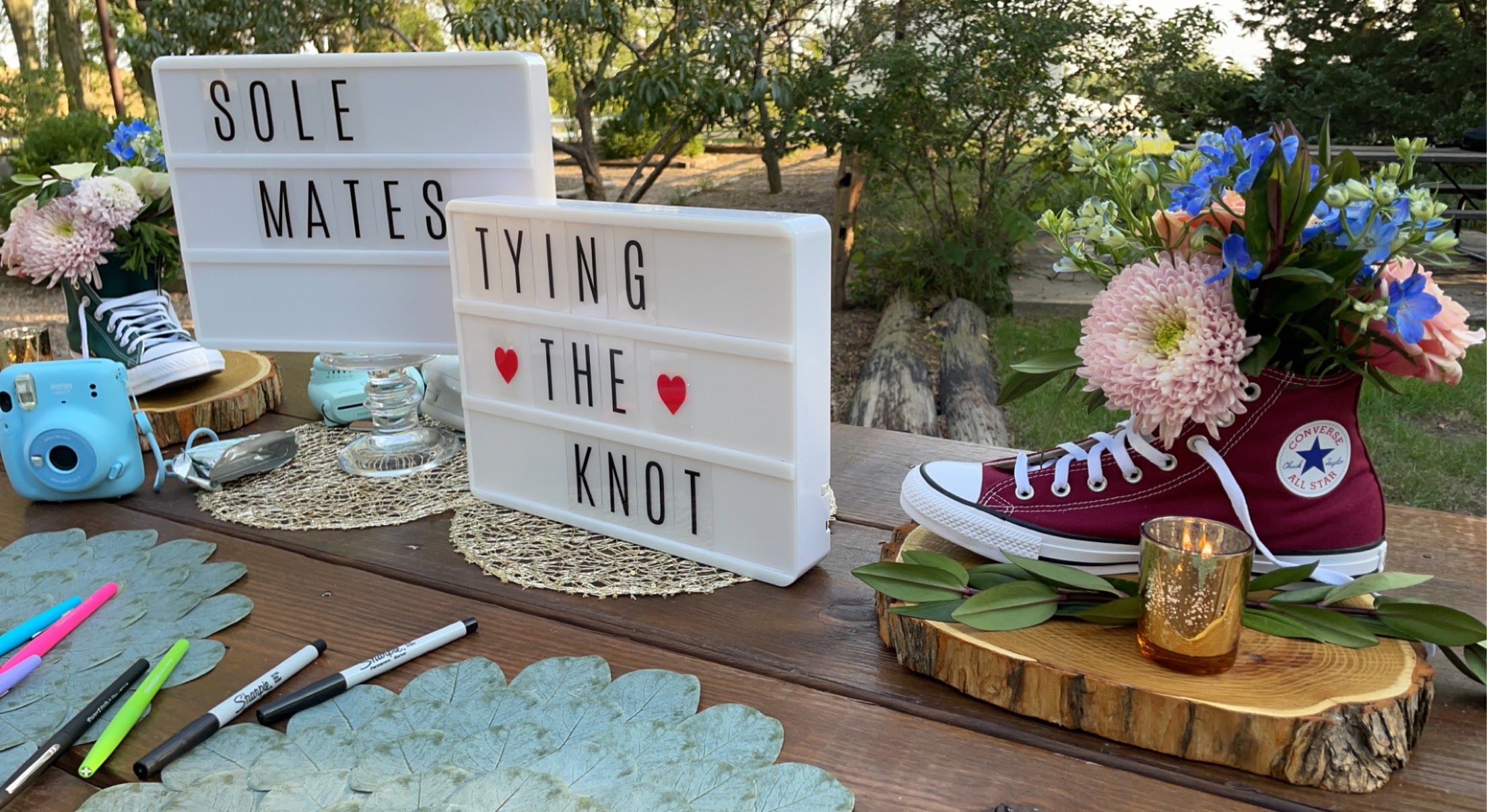
Last week I officiated a wedding. Now those of you who know me are saying...what? You? I know you might be wondering what that lovely young couple was thinking. I was asking the same question. Of all the people they could have chosen...

FYI: I wanted to write about this for my most out-of-the-box moment in May, but it had not yet happened, and I didn’t want to get ahead of myself...or jinx anything! 

Let me be clear, I’m not sure I’ll ever be able to completely describe how honored I was to be asked. At the same time, I won’t deny being terrified. Such a mixture of emotions!

When they invited me to dinner in March, I thought they might ask if I would cut the cake at their September wedding. Well, obviously, I did not know what they were thinking. Yes, I was stunned. And yes, I was nervous. And yes, after we wrote the script I practiced for many weeks. But practicing in front of the mirror is not the same as standing in front of a family that you love and admire, wanting to make sure you don’t trip walking up the aisle before the ceremony begins, or lose your voice...or faint! Yes, all those scenarios crossed my mind between March and September!

Welcome Family and Friends. 

Thank you for being with us today. On this day of joy!

It is love that brings us here today.

That’s how it began. The first words of the ceremony.

What was most important for me was that each and every word of their ceremony be what they wanted it to be, determining what was most important to them, and to their hearts. Not that the exquisite flowers or the beautiful setting or the stunning dress or the lovely decorations were not important. But for me, it was about the words spoken. That was the role I hoped to fulfill. Speaking the love.

Creating the ceremony involved writing the script, finding the perfect words to describe the love I saw, heard and felt when talking with them. Contemplating the perfect words needed to describe this beautiful relationship to all in attendance. 

I watched them interact in March. They were blissfully happy. Listening to the early discussions, thinking about everything that needed to be done, moving through summer and into fall. There were more conversations than they might have wanted with me. And they were still blissfully happy. 

And then suddenly it was September and I was standing within inches of them as they made these vows.

I ask you to be no one other than yourself.

Loving what I know of you and trusting what I do not yet know,

I will respect your integrity and have faith in your abiding love for me,

Through all our years and in all that life may bring us.

Yes, it all came together. They were beaming, as they did when they sat across from me in March, enjoying every moment of their wedding. The feeling in the air, not simply because the air quality was better, or because it was a lovely outside venue on a gorgeous September evening, but truly, because of the love in the air. Love. Joy. As simple as that.


I also had the vantage point of watching the faces and listening to the wonderfulness of their friends attending the wedding. They and their friends inspire great hope for our future. They are all smart and funny and excited about where they will land in the world as they leave college and begin their professional careers. They are looking forward. They will make our world better. Most importantly, they exude the great value of strong friendships.  

I have not talked to them since the wedding. They have flown off into the sunset. As it should be. But my hope is that the ceremony was everything they had hoped it would be, and more. And that their life will indeed be filled with the love and joyfulness and laughter that was shared by all at their wedding. 

I don’t know why they picked me. But I will be forever grateful.

Thank you, my fine young friends, for allowing me to be part of your life’s journey. It was indeed an honor to witness the beginning of your partnership.

A partnership like no other. Where the best part of each day is your time together.


Follow us on Facebook at 5 Women Mayhem


Saturday, September 9, 2023

Fighting for dreams

By JoAnne Young

“Hope lives in the shadow of this state’s Capitol,” I wrote in a Journal Star article six years ago. “It resides in the blocks that surround the Capitol square and stretches into Lincoln’s more irregular neighborhoods.” 

I wrote about the people who lived in that shadow, a seventh-grader who attended a parochial school across the street, a school that has since closed. I wrote about a young community activist living in an apartment in that shadow, with no car and no bike, who walked every work day to her job as a paraeducator at a Lincoln school. A family living paycheck to paycheck, who stood in a line each month at a Lincoln church to get food. 


In that shadow, those and many others who lived and worked and went to school there had hope. Their hope was for jobs and housing assistance, for prison reform and health care that fit their needs. For the rights and freedom and choices to live their lives without the dictate of politics. 


Now I see, when I visit our imposing Capitol, the shadows have moved inside. I apologize to our founders, but I roll my eyes each time I pass under the words: Political society exists for the sake of noble living.


I have always loved our Capitol, the carved marble and tile, the words etched in the stone, the principles it was built on, the hope it could offer. I had an office there for 14 years. I’ve sat in the Rotunda many nights after closing … 8 o’clock, 9 or 10 … when it was quiet and dimly lit and smelling of the soap used to buff the floors. There, I could marvel at its creation, its beauty and meaning, and how lucky I was to be there. 


Now, I see it more often in darkness. An absence has settled in, of love and openness for all the people who have a right to claim it. Hope has been covered over by political agenda. 


In that darkness, though, are fragments of light. Sometimes it falls on the messages we shouldn’t miss. The darkened library light perched beside our law books. Virtues of hope, courage, wisdom, justice, joining hands at the top of the dome, where fourth graders are told to look and learn. The life-giving winged figure casting seeds and flowers across the landscape despite the shadows closing in. 


The writing above the bench in the locked Supreme Court, seen through the glass dimly: “Eyes and ears are poor witnesses when the soul is barbarous." 


The Greek philosopher who is quoted there is the same who is credited with the idea that the only thing constant in life is change. We can't go backward or stand still. 


This is a condolence message, as it were, for all those who have been wronged by events and decisions in this arrestingly consequential building, those who have been shoved into its shadows. 


It is also a get-well-soon wish, that the light we see when the curtains are pulled back can heal it. We are not children, but on their behalf, we have become tethered to this state’s survival. My children were born here. Two of my grandchildren were. They have all left now. I want them to have something good to remember besides a state that turned its back on so many.


We can’t stay huddled in the darkness where selected officials believe they represent us. Represent me. In a place where, for me, trust is being peeled away session by session, election by election.  


“No matter how fast light travels,” says writer Terry Patchett, “it finds the darkness has always gotten there first and is waiting for it.”


Dreaming, says writer Jean Genet, is nursed in darkness. But then those dreams have to find the light, or else they fade. We can’t remember them. In the light we can remember the people who have rallied on our Capitol steps, who have fought for their dreams in hearing rooms. Who have reasoned and sometimes shouted their needs in the Rotunda, begging, “please don’t make us leave.”


In the light of this building, people have acted out their fears and watched as others acted out their power. 


“Someone I loved once gave me a box full of darkness,” wrote poet Mary Oliver. 


It took her years to understand that it would turn out to be a gift. 


Darkness can be debilitating, such that action seems pointless, someone once explained. Pointless but enormously necessary at the same time. The opportunity for hope exists in turmoil. 


Follow us on Facebook at 5 Women Mayhem and share our blogs with your friends. We'd be ever so grateful. 


Saturday, September 2, 2023

A Hum in the Universe


By Marilyn Moore

It’s there…a hum in the universe.  Hummmmm, ambient noise, part of what some astrophysicists call a cosmic symphony, evidence that the universe is not static, but rocking and rolling, changing, expanding, shifting shapes….and singing.   A low-pitched hum, way lower than humans can detect, but “heard” by gigantic telescopes, measuring emissions from hundreds of thousands of pulsars.  Telescopes in every continent of the planet, except for Antarctica.  Planetary agreement among the astrophysicists that indeed the universe is humming.  

The source of the universe’s hum?  Most likely it’s from gravitational waves, coming from the spiraling and merging of pairs of black holes throughout the galaxies.  Perhaps the black holes are dancing?  I like the image of dancing, great big, huge black holes, dancing in space, a dance that makes music….it reminds me of the Northern Lights, that danced the night away…I wonder if they were making music…

Last summer the James Webb telescope let us see the universe in ways never seen before—we could see the birth of stars, billions of years ago.  Again, they were dancing….and exploding with life and light and energy and, dare I say, joy.  This summer, we learn that the universe is humming…another cause for wonder, at a time that I need a little wonder in my life.

I think, though, that while the astrophysicists are just now able to quantify, and verify, the humming of gravitational waves, there are those who live amongst us that have somehow always been aware of the universe’s hum.  They most likely did not “hear” it, at least in the sense that we think about hearing a spoken word, a trumpet’s note, a child’s laughter, but they have sensed that hum, a deep-within-the-soul visceral connection to the universe.  Across continents and across cultures, indigenous peoples drummed, and still do, to an internal beat, to a deeply felt vibration, that connected them to one another and to the earth.  I sense that harmony in the words of Black Elk, in the drums of the Masai and the Ponca.  Perhaps that is what those we describe as “old souls” are sensing, are feeling as the source of wisdom and groundedness.

And the critters….what about the critters?  If you’ve been on the prairie on a summer day, or in your own back yard at close of day in late summer, you hear the buzz of bees and the song of the cicadas.  I don’t think they hear the hum of the universe any more than people do, but perhaps they sense the vibration, and they join the chorus.  Or a flock of birds, on the ground, who seemingly without warning and without signal, all rise in flight together.  Are they responding to the universe’s vibration?  What about migratory animals, the zebra, the wildebeest, the Sandhill cranes, the Monarch butterflies…do they move with some thousands-of-years-old pull, in concert with gravitational waves from black holes?  

And finally, what about us?  People, that is.  If there are gravitational waves that create an ambient hum throughout the universe, is that hum embedded in us, too?  In our cells?  In our DNA?  Do our cells hum at a level that can’t be heard, but can be felt?  Do we give off energy, that either repels, or attracts, those we meet?  Is my sense (sometimes) of being “at one with the universe” a function of my cellular hum being the same, or in harmony with, that of the universe?  And when I’m out of sorts, has my cellular hum jumped pitches?  Can I fix that, because I always like to think that I can fix anything?  Or do I have to just stop, and let myself be drawn back into the universe’s hum?  

I think about that hum, and I wonder what the note is.  If the astrophysicists have written about that, I haven’t read it.  I think they’re focusing on other questions…but I wonder what note it is.  In my mind’s ear, I’m hearing a C, many octaves below Middle C, much lower than the C the 32ft. pipe on a pipe organ can produce.  But I hear a C.  I hear it in a classical music context, because that’s what I think of.  Others may hear it in jazz, in ballad, in rap, in a march, in a lullaby, in a folk song, in any of music’s many forms.  But throughout all, it’s the universe’s hum….a single tone, wrapping all of us together.  Imagine, we're bound together by the gravitational waves, emanating from colliding and merging black holes throughout the universe....in a summer when much seems to divide us, I'm glad to know there's a hum that holds us together.

And like the images from the James Webb telescope last summer of the exploding births of stars and galaxies, the discovery of the universe’s hum this summer is one that I can’t quite wrap my mind around…it’s bigger and more complex than my brain can understand.  But my soul gets it….and I am grounded in the hum.


Follow us on Facebook at 5 Women Mayhem.